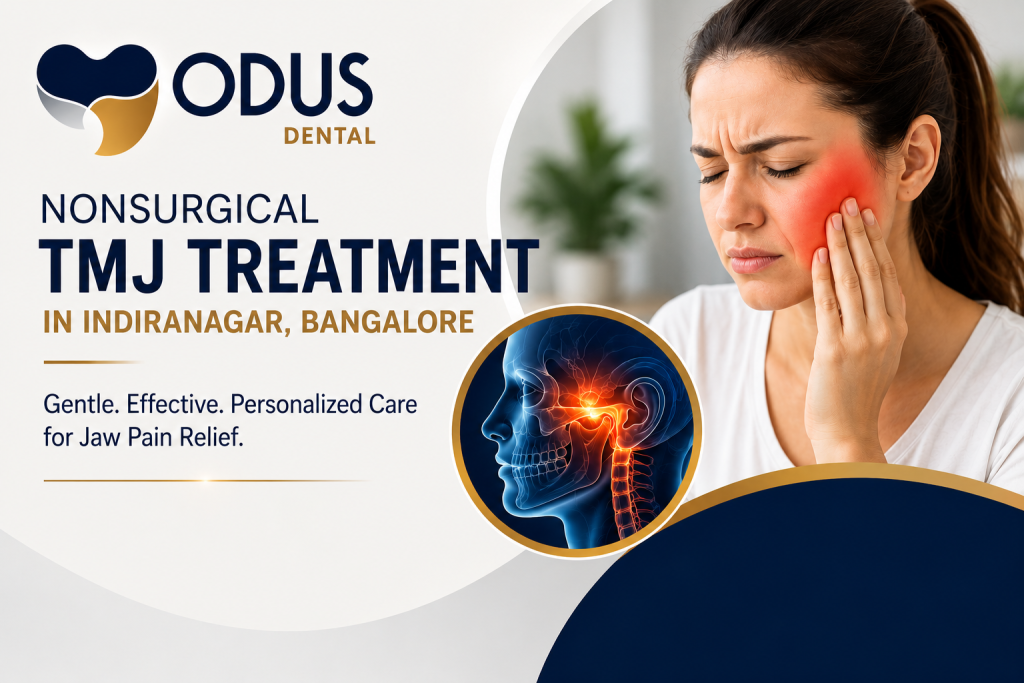
Jaw pain can be surprisingly disruptive. Simple activities such as eating, talking, yawning, or opening the mouth can become uncomfortable when the jaw joint is not functioning properly. Some people notice clicking or popping sounds, while others experience stiffness, facial pain, headaches, or difficulty opening their mouth.
These symptoms may be related to the temporomandibular joint, commonly called the TMJ. The TMJ is one of the most frequently used joints in the body because it is involved every time we chew, speak, swallow, or move the jaw.
The good news is that TMJ problems do not always require surgery. In many cases, appropriate evaluation followed by conservative or nonsurgical treatment can help manage symptoms and improve jaw function.
For individuals searching for TMJ Treatment in Indiranagar, understanding the causes, symptoms, diagnosis, and nonsurgical treatment options can help them make an informed decision about their dental care.
What Is the Temporomandibular Joint?
The temporomandibular joint connects the lower jawbone to the skull. There is one joint on each side of the face, located just in front of the ears.
These joints work together with the jaw muscles, ligaments, and surrounding structures to allow the mouth to open and close smoothly. They also enable the jaw to move forward, backward, and from side to side.
When the joint, muscles, or surrounding structures become irritated or overloaded, a person may develop temporomandibular disorders, commonly referred to as TMD.
TMJ problems can have several possible causes. Teeth grinding, jaw clenching, stress, trauma, arthritis, prolonged chewing, certain dental conditions, and muscle tension may contribute to symptoms.
Common Symptoms of TMJ Disorders
TMJ problems can present differently from one person to another. Some people experience mild symptoms, while others may have persistent discomfort that affects their daily activities.
Common symptoms include:
- Jaw pain or tenderness
- Clicking or popping while opening the mouth
- Difficulty chewing
- Jaw stiffness
- Limited mouth opening
- Pain around the ears
- Facial muscle soreness
- Headaches or temple discomfort
- Jaw locking
- Pain while yawning
- Changes in comfortable jaw movement
A clicking sound by itself does not necessarily mean that treatment is required. However, clicking accompanied by pain, locking, swelling, or restricted movement should be evaluated by a dental professional.
Why Does TMJ Pain Happen?
There is rarely one single cause behind every TMJ problem.
One of the common contributing factors is excessive pressure on the jaw. People who frequently clench their teeth during the day or grind their teeth while sleeping may place additional stress on the jaw muscles and joints.
Stress can also contribute to unconscious clenching. Long hours of concentration, computer work, driving, or emotional stress may cause some individuals to keep their teeth tightly together without realising it.
Other potential factors include:
- Previous injury to the jaw
- Arthritis affecting the joint
- Muscle inflammation
- Poor jaw habits
- Excessive chewing
- Certain bite-related issues
- Repeated strain on the jaw
A proper examination is important because treatment should address the factors contributing to the symptoms rather than simply focusing on pain relief.
Nonsurgical TMJ Treatment in Indiranagar
Not every patient with TMJ symptoms needs surgery. Depending on the diagnosis and severity of the condition, conservative treatment may be recommended initially.
The objective of nonsurgical care is generally to reduce strain on the jaw, manage discomfort, improve function, and address contributing habits.
Treatment may involve one or more of the following approaches.
1. Oral Appliances and Night Guards
Patients who grind or clench their teeth may benefit from a professionally evaluated oral appliance.
A night guard can help protect the teeth from excessive wear caused by grinding. In selected cases, an appropriate splint may also be incorporated into the overall management plan.
The type of appliance and wearing schedule should be determined by a dentist after assessing the patient’s jaw and dental condition.
2. Jaw Exercises
Specific jaw exercises may be recommended to improve controlled movement and reduce muscle tension.
Exercises can vary depending on the individual’s condition. Some patients may benefit from gentle movement exercises, while others may require techniques focused on muscle relaxation and improving jaw coordination.
Patients should avoid aggressively exercising a painful jaw without professional guidance, as inappropriate movements may worsen symptoms.
3. Physiotherapy
Some TMJ conditions can benefit from physiotherapy focused on the jaw, facial muscles, neck, and posture.
Depending on the patient’s needs, therapy may include controlled exercises, muscle relaxation techniques, manual therapy, and posture-related strategies.
Because jaw function is connected with surrounding muscles and structures, addressing muscle tension may be an important part of conservative management.
4. Managing Teeth Clenching
Daytime clenching is often overlooked because many people are not aware that they are doing it.
A useful starting point is becoming conscious of the jaw position during work, driving, exercising, or stressful situations. Unless chewing or swallowing, the teeth generally do not need to remain tightly together.
Relaxation techniques and behavioural awareness may help reduce unnecessary muscle activity.
5. Dietary Changes
When the jaw is painful, eating very hard or chewy foods can increase discomfort.
A dentist may recommend temporarily choosing softer foods and avoiding items that require prolonged chewing. Cutting food into smaller pieces may also reduce the amount of work required from the jaw.
These changes are generally supportive measures rather than a permanent restriction.
6. Heat and Cold Therapy
Depending on the nature of the symptoms, warm or cold compresses may provide temporary relief.
Warmth can sometimes help relax tense muscles, while cold may help with certain types of acute discomfort.
Patients should follow professional guidance regarding which approach is suitable for their symptoms.
7. Medication When Required
In some situations, medication may be recommended to manage pain or inflammation.
Any medication should be taken only according to the advice of a qualified healthcare professional, particularly for people with existing medical conditions or those taking other medicines.
Medication may help control symptoms, but identifying the underlying cause remains an important part of long-term management.
Meet Dr. Madhusmita at Odus Dental
For patients looking for a dental professional experienced in managing TMJ-related concerns in Indiranagar, Dr. Madhusmita Hazarika Hegde at Odus Dental & Implant Centre is a relevant option to consider.
Dr. Madhusmita is an MDS-qualified Prosthodontist with clinical expertise that includes TMJ management, along with full-mouth rehabilitation, dental implants, cosmetic dentistry, and prosthodontic care.
Her approach to TMJ-related concerns begins with understanding the patient’s symptoms and evaluating the jaw and surrounding structures before determining an appropriate treatment plan.
This is particularly important because jaw pain can have different causes. Two patients with similar symptoms may require completely different approaches depending on the underlying problem.
For patients seeking a TMJ Specialist in Indiranagar, consulting an experienced dental professional can help determine whether the symptoms are related primarily to the joint, jaw muscles, teeth grinding, clenching, or another contributing factor.
How Is TMJ Diagnosed?
A detailed consultation is an important first step.
During a TMJ evaluation, the dentist may ask about:
- When the symptoms started
- Whether pain occurs during chewing
- Presence of clicking or popping
- History of teeth grinding
- Daytime jaw clenching
- Previous jaw injuries
- Difficulty opening the mouth
- Headaches or facial discomfort
- Episodes of jaw locking
The dentist may examine jaw movement, muscle tenderness, joint sounds, and the range of mouth opening.
In selected cases, imaging may be recommended to obtain additional information about the joint or surrounding structures.
A diagnosis should be based on clinical findings rather than symptoms alone.
Who May Benefit From Nonsurgical TMJ Care?
Conservative treatment can be considered for many patients, particularly when symptoms are associated with muscle tension, clenching, grinding, inflammation, or functional problems.
However, the appropriate treatment depends on the diagnosis.
Some patients may experience improvement with simple habit modifications and exercises, while others may require a combination of oral appliances, physiotherapy, and other conservative measures.
In more complex cases, further investigation may be required.
This is why an individual evaluation is more useful than following a generic TMJ treatment plan found online.
When Should You Consult a TMJ Specialist?
Not every jaw click requires treatment, but persistent or painful symptoms should not be ignored.
Consider consulting a TMJ Specialist or dentist experienced in TMJ management if you experience:
- Persistent jaw pain
- Pain while chewing
- Difficulty opening the mouth
- Repeated jaw locking
- Painful clicking or popping
- Facial muscle soreness
- Frequent headaches associated with jaw discomfort
- Symptoms that are getting worse
Early assessment can help identify contributing factors and determine whether conservative care is appropriate.
TMJ Treatment in Indiranagar: A Personalised Approach
There is no single treatment that works for every TMJ patient.
The most appropriate approach depends on the underlying cause, severity of symptoms, duration of the problem, jaw function, dental condition, and individual habits.
At Odus Dental, the treatment approach can be tailored according to the patient’s specific clinical needs. When appropriate, nonsurgical options may be considered before more invasive procedures.
The goal is to help patients achieve more comfortable jaw movement while reducing unnecessary stress on the joint and surrounding muscles.
Can TMJ Problems Be Prevented?
While not every TMJ problem can be prevented, certain habits may help reduce unnecessary stress on the jaw.
Patients can consider:
- Avoiding excessive chewing of gum
- Reducing unnecessary jaw clenching
- Avoiding very hard foods during painful episodes
- Maintaining good posture
- Managing stress
- Following professional advice for teeth grinding
- Seeking evaluation when symptoms persist
Being aware of jaw tension throughout the day can also be useful. Many people do not realise they are clenching until they consciously pay attention to it.
Why Choose Nonsurgical Treatment?
The biggest advantage of conservative treatment is that it focuses on managing the condition without immediately moving toward invasive procedures.
For appropriate patients, simple interventions such as behavioural modification, oral appliances, physiotherapy, exercises, and dietary changes may provide meaningful improvement.
However, nonsurgical treatment should not be viewed as a universal solution. If symptoms persist despite conservative care, further evaluation may be required.
A qualified dental professional can guide the patient through the available options based on the diagnosis.
Get Expert Evaluation for Jaw Pain in Indiranagar
Jaw pain, clicking, stiffness, and difficulty chewing can interfere with everyday life. Although TMJ symptoms may sometimes seem minor, persistent discomfort deserves proper attention.
The good news is that many TMJ conditions can initially be managed with conservative approaches, depending on the underlying cause.
If you are searching for TMJ Treatment in Indiranagar, consulting Dr. Madhusmita at Odus Dental & Implant Centre can help you understand your symptoms and explore appropriate nonsurgical treatment options.
Rather than continuing to live with recurring jaw pain, a professional evaluation can help identify the possible cause and create a treatment plan suited to your individual needs.
Odus Dental & Implant Centre, Indiranagar, Bangalore, provides comprehensive dental care with TMJ management among its areas of expertise.